
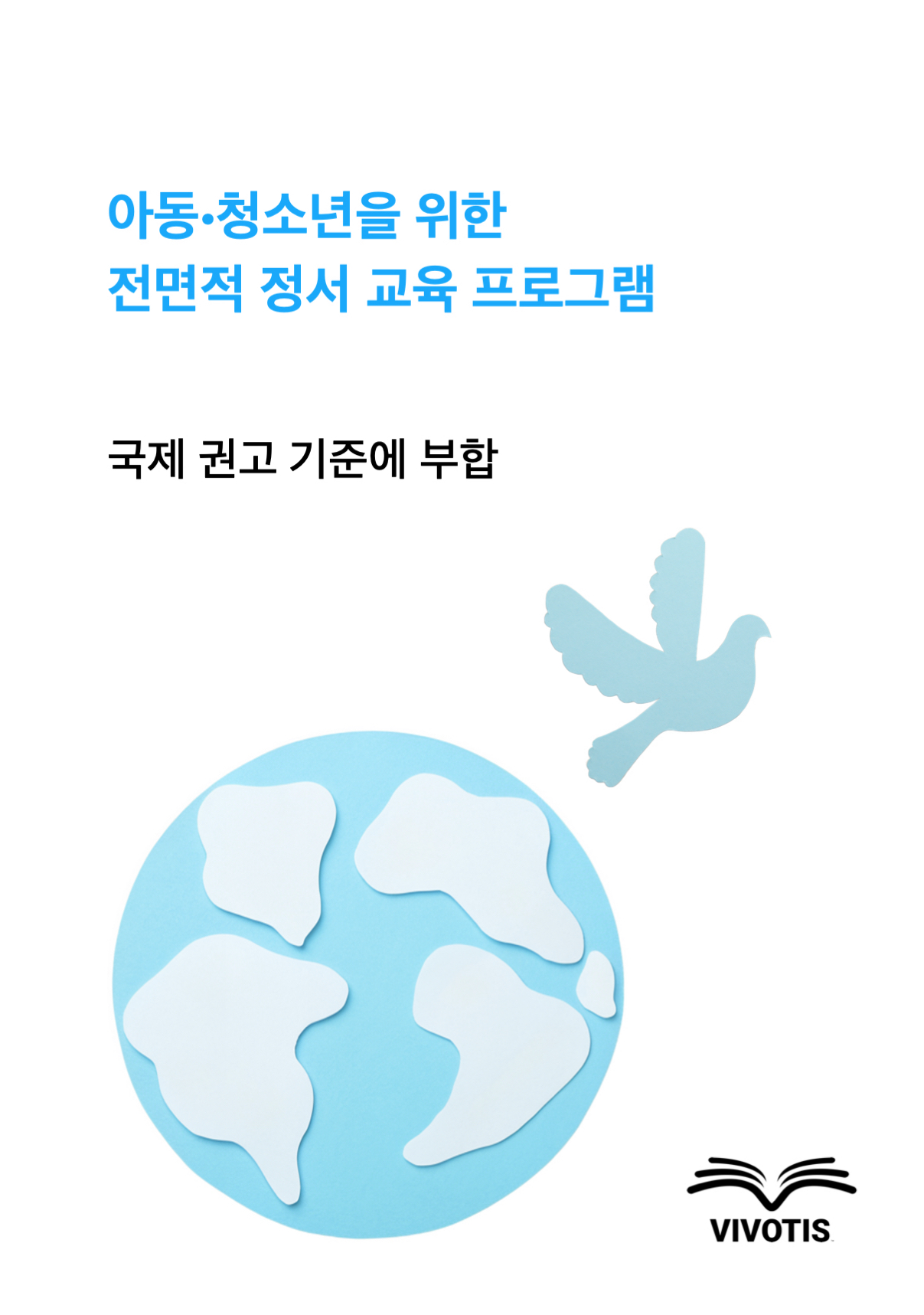
이 책은 세계보건기구(WHO)와 유니세프의 국제 권고에 따른 종합적인 정서 교육 프로그램을 제시합니다. 다양한 문화적 배경을 가진 어린이와 청소년을 위해 고안된 이 책은 모든 개인에 대한 배려, 존엄성, 존중을 바탕으로 정서적, 관계적, 사회적 발달에 대한 글로벌 접근 방식을 제공합니다.
This program supports educators, teachers, health professionals, social workers, and parents in implementing sessions tailored to each developmental stage—from early childhood to adulthood. It explores key areas such as developmental milestones, emotions, consent, relationships, the body, sexual health, and violence prevention, while integrating cultural and legal considerations specific to each country.
Combining scientific rigor with accessible pedagogy, this guide helps practitioners strengthen their skills, adopt an appropriate professional stance, and create a trusting climate that supports learning. More than a manual, it is a universal tool to promote health, equality, responsibility, and inner freedom among younger generations.
PROGRAM OBJECTIVE
Vivotis provides a complete framework to guide facilitators working with children, adolescents, and young adults in building a healthy, respectful, and fulfilling affective life.
Based on international standards (WHO, UNESCO, UNICEF), the program enables professionals to:
— develop young people’s psychosocial skills,
— prevent gender-based and sexual violence,
— promote self-respect and respect for others,
— create a caring and protective educational climate.
EXPECTED OUTCOMES
For children and adolescents:
— improved self-esteem and better emotional regulation,
— understanding of consent, boundaries, and mutual respect,
— reduction of risky behaviors and peer violence.
For facilitators:
— strengthened professional posture based on listening and kindness,
— clear, coherent, and safe intervention framework,
— practical tools to conduct age-appropriate sessions (from age 2).
At the institutional level:
— stronger educational cohesion and a shared prevention culture,
— sustainable integration of affective education into collective practices.
TARGET AUDIENCE
— all education professionals,
— all professionals in health, social work, and child protection,
— all trainers and facilitators in health promotion,
— any school, association, local authority, or NGO seeking to strengthen violence prevention.
BOOK CONTENTS
— the foundations of affective and sexual health education,
— the stages of child and adolescent development,
— the facilitator’s posture and preparation for implementation,
— ready-to-use sessions for the four main age groups,
— practical guidelines and a selected bibliography.
KEY STRENGTHS
— holistic approach respectful of cultures and human rights,
— adaptable to all educational contexts (school, community, healthcare, social work),
— tool for continuous training and direct implementation,
— recommended for implementing affective-education and psychosocial-skills programs.
 English
  العربية
  简体中文
简体中文  Nederlands
  Français
  Deutsch
  हिन्दी
  Italiano
  日本語
日本語  한국어
한국어  Polski
  Português
  Русский
  Español
  Türkçe